A utility project can look straightforward on a map.
Draw a proposed route, identify the parcels it crosses, determine the land rights needed, and move toward acquisition and construction.
The reality on the ground and in the property records is often considerably more complicated.
Before a utility company or infrastructure project team can confidently pursue new property rights, it needs to understand who owns the affected property, what rights already exist, how the land is legally described, and whether recorded documents create complications for the proposed project.
That is where title research for utility projects becomes essential.
Title research helps transform a parcel on a map into a documented picture of property ownership and existing rights. When performed early, it can uncover questions that might otherwise emerge during acquisition, surveying, engineering, or even construction.
For Texas utility projects involving dozens, hundreds, or potentially thousands of parcels, small uncertainties can multiply quickly. An ownership discrepancy on one tract may affect negotiations. An overlooked easement may interfere with a proposed alignment. A problematic legal description may require additional research before a new easement can be prepared.
The goal of title research is therefore not simply to collect documents.
It is to give the project team reliable property information on which later decisions can be based.
For utility and infrastructure projects, that foundation can make the difference between discovering property issues early and reacting to them after they have already affected the project schedule.
What Is Title Research for Utility Projects?
Title research is the process of examining public property records and related documents to identify ownership, existing interests, recorded rights, and other information associated with a particular tract of land.
In a residential transaction, title research is commonly associated with buying or selling a home. Utility projects have a different objective.
A utility project may need information about many properties along a linear corridor. The project team may be evaluating where facilities can be located, determining which landowners must be contacted, identifying existing easements, or preparing to acquire new rights.
Depending on project scope, right-of-way title research may involve reviewing documents such as:
- deeds and vesting instruments;
- recorded easements;
- rights-of-way;
- plats;
- legal descriptions;
- releases;
- assignments;
- probate-related records;
- liens or other recorded interests relevant to the project; and
- historical conveyances affecting the property.
The precise research required depends on the project and the rights being sought.
The important distinction is that utility title research is connected to a larger land-rights process. Researchers are not merely answering, “Who owns this property?”
They may also need to help answer questions such as:
- Who holds the current record interest?
- How was that interest acquired?
- Does the property already contain a utility easement?
- What rights does an existing easement grant?
- Has an easement been assigned, amended, released, or otherwise affected by later documents?
- Does the legal description correspond with the area the project team believes it does?
- Are there ownership or record issues requiring additional investigation?
These questions can directly influence what happens next.
Why Property Records Can Become a Right-of-Way Bottleneck
Right-of-way work depends on accurate information.
If the ownership information at the beginning of the process is incomplete or outdated, later activities may be built on a weak foundation.
Imagine a project team preparing an acquisition package using an owner name from an easily accessible property database. Later research shows that the property was transferred, inherited, divided, or placed into another ownership structure.
The project team may then need to revise its documentation and determine who actually holds the interest needed for the transaction.
Multiply that scenario across a long linear project and the scheduling consequences become easier to understand.
Property records can also reveal complications that are invisible when looking at an aerial image or preliminary alignment.
A tract that appears simple geographically may have a complicated ownership history. Conversely, a visually complicated property may have a well-documented chain of title.
This is why Texas property records should be treated as an important part of project due diligence rather than a clerical detail that can wait until acquisition is already underway.
What Title Research Should Identify Before Acquisition Begins
The scope of research varies, but several categories of information are especially important for utility projects.
Current Ownership
Before contacting a property owner about a proposed easement or other land right, the project team needs reliable information about who holds the relevant ownership interest.
That sounds obvious, but real property ownership can become complicated.
A deed may identify multiple owners. Property may pass through an estate. An entity may own the land. Interests may have been divided among parties. Recent transactions may change information that appears in other property databases.
Reliable property ownership research gives acquisition teams a more defensible starting point.
Vesting Documents
The vesting instrument establishes how the current owner acquired the property.
Reviewing that document can provide critical information about ownership, legal descriptions, reservations, exceptions, and references to earlier recorded documents.
It can also point researchers deeper into the chain of title when additional investigation is required.
Existing Easements and Rights-of-Way
A proposed utility route rarely exists in a vacuum.
Property may already be affected by electric, pipeline, telecommunications, water, drainage, access, road, or other recorded rights.
Finding these interests early can help project teams understand the existing property-rights environment before trying to establish another one.
Legal Descriptions
A legal description identifies land in a way that can be tied to recorded property rights.
For utility projects, researchers may encounter descriptions based on lots and blocks, metes and bounds, surveys, abstracts, subdivisions, or other systems.
The description must be evaluated in the context of the documents and project needs.
Recorded Changes to Existing Rights
An old easement may not tell the whole story.
Later records could amend it, assign it, partially release it, terminate it, or otherwise affect the rights originally granted.
That is why researchers may need to follow the documentary history rather than stopping at the first relevant instrument they find.
How Title Problems Create Utility Project Delays
Title issues do not necessarily stay inside the title department.
They can spread into acquisition, surveying, mapping, engineering, legal review, and project management.
Consider a few common scenarios.
The Wrong Owner Is Identified
If acquisition efforts begin with outdated ownership information, communications and documents may need to be redirected or recreated.
The issue becomes more significant when ownership is divided among multiple parties or additional research is needed to determine the current interests.
An Existing Easement Is Discovered Late
Suppose engineering progresses under assumptions about available land rights, only for a previously unidentified recorded easement to surface later.
The team may need to evaluate whether the proposed facilities conflict with existing rights or whether the alignment and acquisition strategy need adjustment.
The earlier the existing interest is identified, the more options the project team typically has for incorporating that information into planning.
A Legal Description Raises Questions
If the underlying property description is unclear, inconsistent, or difficult to reconcile with other records, additional research or surveying coordination may be required.
Waiting until acquisition documents are being finalized to resolve those questions can interrupt the workflow.
Ownership Changes During a Long Project
Infrastructure projects can take years.
Property does not stop changing hands while a project is being planned.
A tract researched early in development may be sold before acquisition occurs. Maintaining current ownership information can therefore become part of the ongoing land-rights process rather than a one-time exercise.
The Role of County Property Records in Texas
Texas utility projects operate across a state with 254 counties, and real-property records are maintained at the county level.
The county clerk’s real-property records can contain deeds, easements, releases, assignments, plats, and other recorded instruments that help researchers reconstruct the relevant history of a tract.
Researchers may also consult appraisal district information as a useful starting point for parcel and ownership information. However, appraisal records and recorded title documents serve different purposes.
For title research, the recorded instruments themselves are critical.
A name appearing in a searchable database may point researchers in the right direction, but effective title research often requires following references from one recorded instrument to another.
Think of it as assembling a documentary chain rather than performing a single database lookup.
One deed points backward to an earlier deed. That document references an easement. The easement contains a legal description. A later document may modify the easement.
Each record adds another piece to the property picture.
Title Research and the Chain of Title
The chain of title describes the sequence of recorded ownership transfers affecting a property over time.
For utility projects, tracing that chain can become necessary when current ownership cannot be fully understood from the latest deed alone or when researchers need to determine how an existing right originated.
For example, a current deed may reference exceptions established decades earlier.
Those exceptions may lead to recorded easements or reservations that remain relevant to the proposed project.
A chain-of-title review can also reveal changes in property configuration.
A large parent tract may have been divided into smaller parcels. Several parcels may have been combined. A conveyance may have excluded a particular area. Subdivision activity may have created new lots, streets, reserves, or easements.
Understanding those changes helps researchers connect historical documents to today’s project geography.
That connection is especially important for linear infrastructure because a project corridor can cross properties with dramatically different histories.
One mile of proposed utility line might involve a recently developed subdivision, an older rural tract, commercial property, and land that has remained within the same family for generations.
Each tract can present a different research challenge.
Easements, Encumbrances, and Existing Property Rights
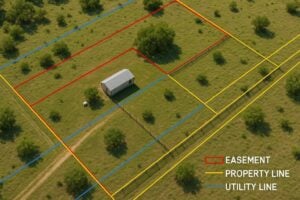
An easement generally grants specified rights to use another person’s land for a particular purpose without transferring full ownership of the property.
For utilities, easements can provide rights associated with constructing, operating, accessing, maintaining, replacing, or removing facilities, depending on the language of the instrument.
The exact document matters.
A line drawn on a GIS layer cannot explain every legal right contained in the recorded easement behind that line.
Title researchers may therefore need to locate the underlying instrument and identify information relevant to the project team.
That could include the parties, recording information, legal description, purpose, referenced exhibits, and later instruments affecting the easement.
Existing property rights can matter even when they belong to a different type of infrastructure.
For example, a proposed electric facility may encounter pipeline, access, drainage, telecommunications, or other recorded rights within the same general area.
Identifying those interests does not automatically mean a conflict exists. It means the project team has better information with which to evaluate the proposed corridor.
Building a Stronger Foundation for Texas Utility Projects
Successful utility infrastructure depends on more than poles, pipelines, conductors, fiber, equipment, and engineering plans.
It also depends on the rights that allow those facilities to occupy and cross land.
Those rights begin with understanding the property.
Effective title research for utility projects helps establish that understanding by connecting ownership, recorded documents, legal descriptions, easements, and historical property information to the needs of the project.
Done early, it can help teams identify complicated parcels before they reach critical acquisition stages.
Done carefully, it can improve the quality of information flowing between title researchers, right-of-way professionals, surveyors, GIS teams, engineers, and project managers.
And done with the larger project objective in mind, it becomes more than a search for deeds.
It becomes part of risk management.
For Texas utility and infrastructure projects, where linear corridors can cross properties with dramatically different ownership histories, early property research provides something every project team needs: fewer unknowns.
The route shown on a project map may ultimately be measured in miles.
But successful right-of-way work is often determined one property record, one ownership interest, and one tract at a time.
FAQs
What is title research for utility projects?
Title research for utility projects examines property records to identify ownership, recorded easements, rights-of-way, legal descriptions, and other interests that may affect a proposed utility corridor or land-rights acquisition.
Why is title research important before right-of-way acquisition in Texas?
Early title research can help a project team verify ownership and identify existing property rights or record issues before negotiations advance. Discovering those issues earlier gives the team more time to investigate and coordinate an appropriate response.
What property records are reviewed during Texas utility title research?
Depending on the project, research may include deeds, easements, rights-of-way, plats, releases, assignments, legal descriptions, historical conveyances, and other relevant recorded instruments.
Can title research identify existing utility easements?
Yes. Recorded property research can help locate utility easements and related documents affecting a tract. Researchers may also need to investigate amendments, assignments, releases, or other later instruments to understand the documentary history.
How can title problems delay a utility project?
Ownership discrepancies, unidentified property interests, unclear legal descriptions, historical easements, and other title questions may require additional research or coordination. When discovered late, these issues can interrupt acquisition, surveying, mapping, or other ROW activities.